
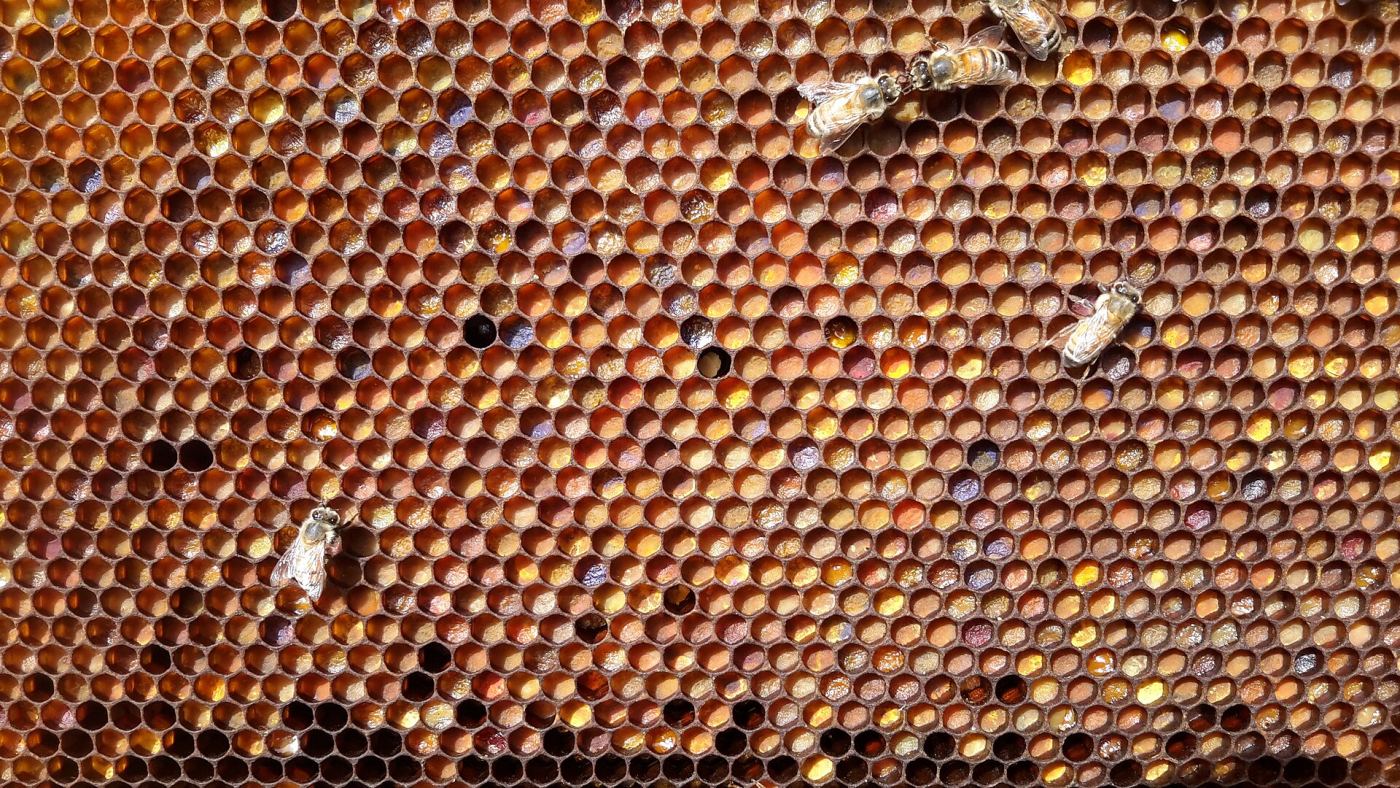
Good news: stingless bees fall ill far less often than honey bees. They have a solid natural defence system — the resin inside the hive (colony) is antibacterial, and the colony is very good at sealing off its entrances.
Less good news: by the time a colony has declined enough for you to see the problem, it is usually too late. So the most important part of this article is not how to treat, but how to spot trouble early at the hive entrance.
Reading the entrance — the most valuable skill there is
You don't need to open the lid. Stand a metre away and watch for two or three minutes on a warm, sunny morning.
A healthy colony: bees coming and going steadily, in a rhythm. Many return with pollen packed on both legs — a sign the colony is raising brood. Guard bees are posted at the entrance.
Cause for concern:
- Only the occasional bee coming and going even in fine weather — the colony is losing numbers.
- Almost no bees bringing pollen home — the colony may be queenless, or may have stopped raising brood.
- Dead bees in front of the entrance — abnormal; open up and check.
- Bees crawling weakly, wings ragged, unable to fly.
- Strange bees of another species hanging around the entrance — the hive may be being robbed.
Five common threats
1. Ants — enemy number one
Not a disease, but the killer of more colonies than anything else. Ants come up the legs of the hive box, steal honey and carry off brood. A weak colony can be cleaned out in a few days.
Signs: a trail of ants running up the legs of the box or around the lid.
What to do: smear grease around the legs of the stand, or stand each leg in a bowl of water. Cut away every "bridge" leading into the box: branches touching the roof, climbing vines, tall grass. Check again regularly, because grease dries out and fallen leaves build new bridges.
Do not scatter ant poison around the box. The bees die too.
2. Termites
They eat the timber of the hive box from the inside; by the time you notice, the box is already rotten.
Signs: thin mud tunnels running along the legs or the walls of the box; a hollow sound when you tap it.
What to do: move the colony into a new hive box straight away. Stand the box up high, away from soil and rotting wood. Prevention still beats cure: choose good timber and use steel legs.
3. Spiders and lizards
They spin webs or lie in wait around the entrance, catching foragers on their way home. The damage is slow but steady.
What to do: clear the cobwebs from around the box during your weekly check. That is all there is to it.
4. Parasitic flies (phorid flies)
Far more dangerous than most people think. The tiny flies lay eggs in the hive, and the fly larvae eat both the pollen and the bee brood.
Signs: on opening the hive you find small maggots in the pollen storage area, the pollen sloppy and smelling wrong.
What to do: remove the infested pollen at once. These flies are drawn to open hives and spilled pollen — so don't leave the hive open for long during an inspection, and clean up any pollen that has spilled. An apple cider vinegar trap set near the box (not right up against it) helps bring the fly numbers down.
5. Mould
A rainy-season problem. The cause is almost always damp: a leaking box, a box sealed so tightly that moisture cannot escape, or a low, damp site.
Signs: white or green patches on the pollen pots, a musty smell when you lift the lid.
What to do: take out the mouldy material, then find and fix the source of the damp. Fail to deal with the cause and the mould comes straight back.
General rules when a colony is in trouble
- Use no chemicals in or around the hive. Stingless bees are highly sensitive. Whatever kills the pest usually kills the colony along with it.
- Treat the cause, not just the symptom. Clear out the mould without fixing the leak and it will be back next week.
- Leave a weak colony alone as far as you can. Every time you lift the lid is another shock. Fix what has to be fixed, then let it be.
- Write it down. The date you noticed it, the signs, what you did, how it turned out. Next time it happens you will know which approach works in your own garden.
In this management system, every hive can carry an alert with a severity level and a deadline for action; if a hive with an open problem goes past the set number of days without anyone updating it, the system sends a reminder on its own. It sounds mechanical, but once you keep a few dozen hives, human memory is no longer enough.