
Keeping stingless bees does not take much work, but the work has to come at the right time. Doing the right job at the wrong moment is sometimes worse than doing nothing at all.
A classic example: splitting a colony at the start of the rainy season. It sounds sensible, because the colony is at full strength after the flowering season — but a freshly split daughter colony is still weak, and running straight into several damp months with few flowers puts it at serious risk.
Below is a calendar of tasks in four stages. The months follow the climate of Tây Nguyên (Central Highlands) and Nam Bộ (southern Vietnam); the north runs on a different schedule and has a cold season as well, so adjust to your own region.
Late dry season, start of the flowering season (roughly December – February)
This is when colonies begin to recover and get ready for their strongest season of the year.
- Give every hive a full check. Open the lid and see whether the brood comb is even, and how much honey and pollen is left in the pots.
- Deal with weak colonies straight away. This is the best moment to save them, because the flowering season lies ahead. Leaving it until the rainy season is usually too late.
- Check the ant and termite defences. Re-grease the legs of the hive stand and clear away fallen leaves that could form a bridge.
- Prepare empty hive boxes if you plan to split colonies — build them early so the wood loses its smell.
Peak flowering season (roughly February – May)
The golden season. In Tây Nguyên this is when the coffee blossoms; in many other areas it is when the fruit trees flower.
- This is the time for colony splits. The colony is populous, food is abundant, and the daughter colony has everything it needs to build up before the rains. See colony split technique.
- Keep unnecessary lid-opening to a minimum. The colony is working flat out; do not interrupt it.
- Watch out for pesticides. The flowering season is also the season when many orchards spray. This is the single biggest risk of the year.
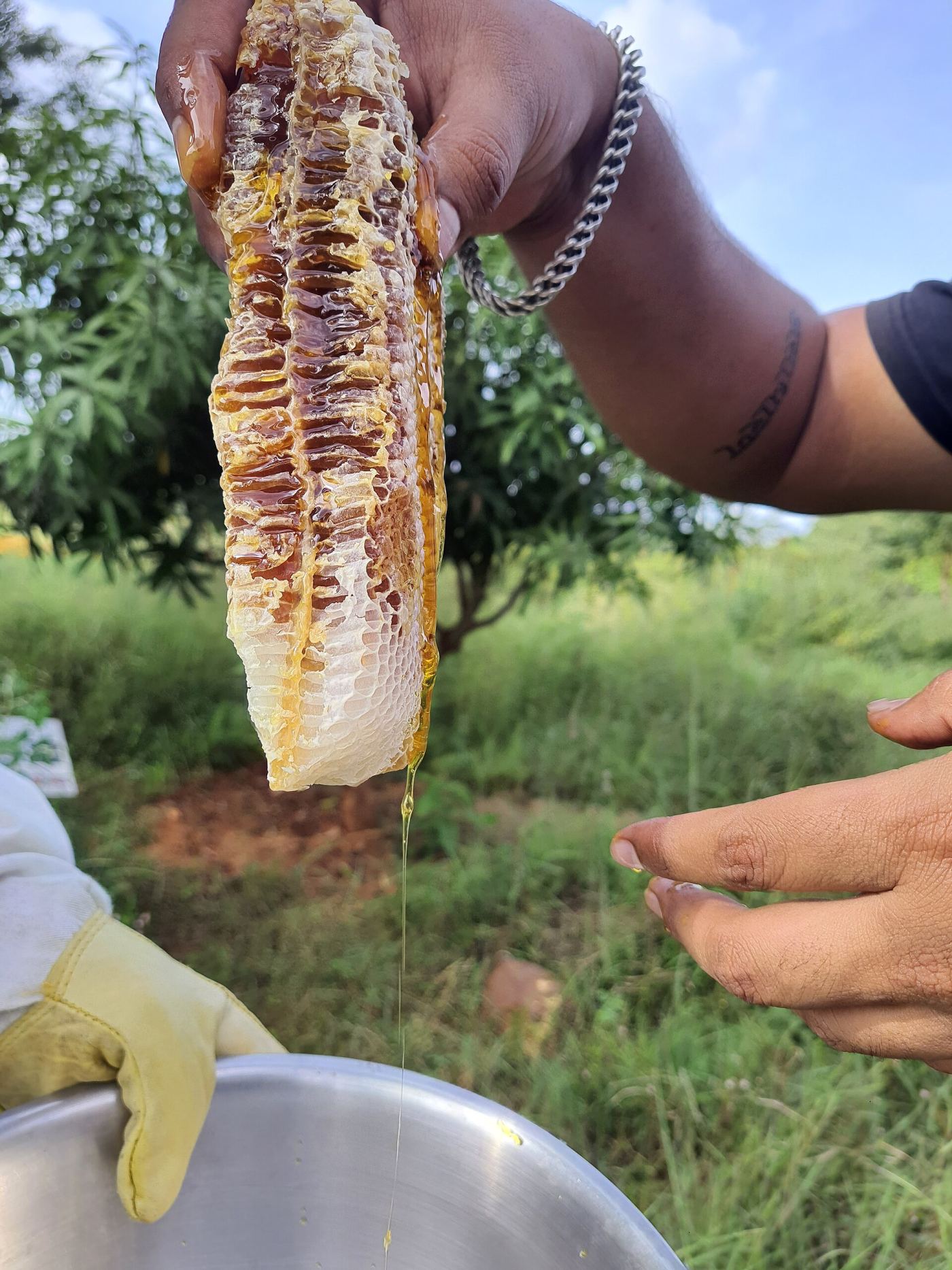
- Only think about harvesting honey at the end of the season — and only harvest when the colony has surplus stores.
Rainy season (roughly June – September)
The hardest stretch. Heavy rain, few chances for the bees to fly, high humidity, and mould finds it easy to take hold.
- Check the roof cover and the drainage. Water leaking into the box ruins the whole colony.
- Do not open the lid on a damp day. Opening it lets moisture pour in, and the bees have to spend their energy regulating it all over again.
- Do not split colonies. A daughter colony will not have time to build up.
- Do not harvest honey. The colony needs its stores to get through the season.
- Watch for signs of mould — open up to inspect only if you see something unusual at the entrance, and pick a dry day for it.
The rule for the rainy season fits in one sentence: leave the colony alone.
End of the rains, start of the dry season (roughly October – November)
The colonies start to recover after the rains.
- Do a full inspection once the rains are over. This is when you find out which hives have gone damp and mouldy and which have lost population.
- Clean around the boxes and clear the weeds that shot up in the rain.
- Feed a supplement if a colony has run its stores down and the flowers are not out yet. A weak sugar syrup, stopped the moment the flowers appear.
- Plan for the coming flowering season: which hives you intend to split, and how many extra boxes you will need.
Year-round tasks
Three jobs that have no season:
- Watch the hive entrance every week. Two or three minutes. Bees coming and going steadily and carrying pollen home means all is well. This is the cheapest and most effective early warning there is.
- Keep records. Date of inspection, what you saw, what you did. After a year you will have a calendar of your own, tailored to your own apiary and more accurate than any general article — this one included.
- Check the ant defences. Grease dries out, and fallen leaves form bridges. A small job, but forgetting it costs you a colony.
In this system, every care visit is logged in each hive's own journal, reached by QR code — date and time, who did the work, photographs. Not for show, but because after a few years that journal is the thing that tells you which colonies are genuinely strong and where the honey actually came from.