
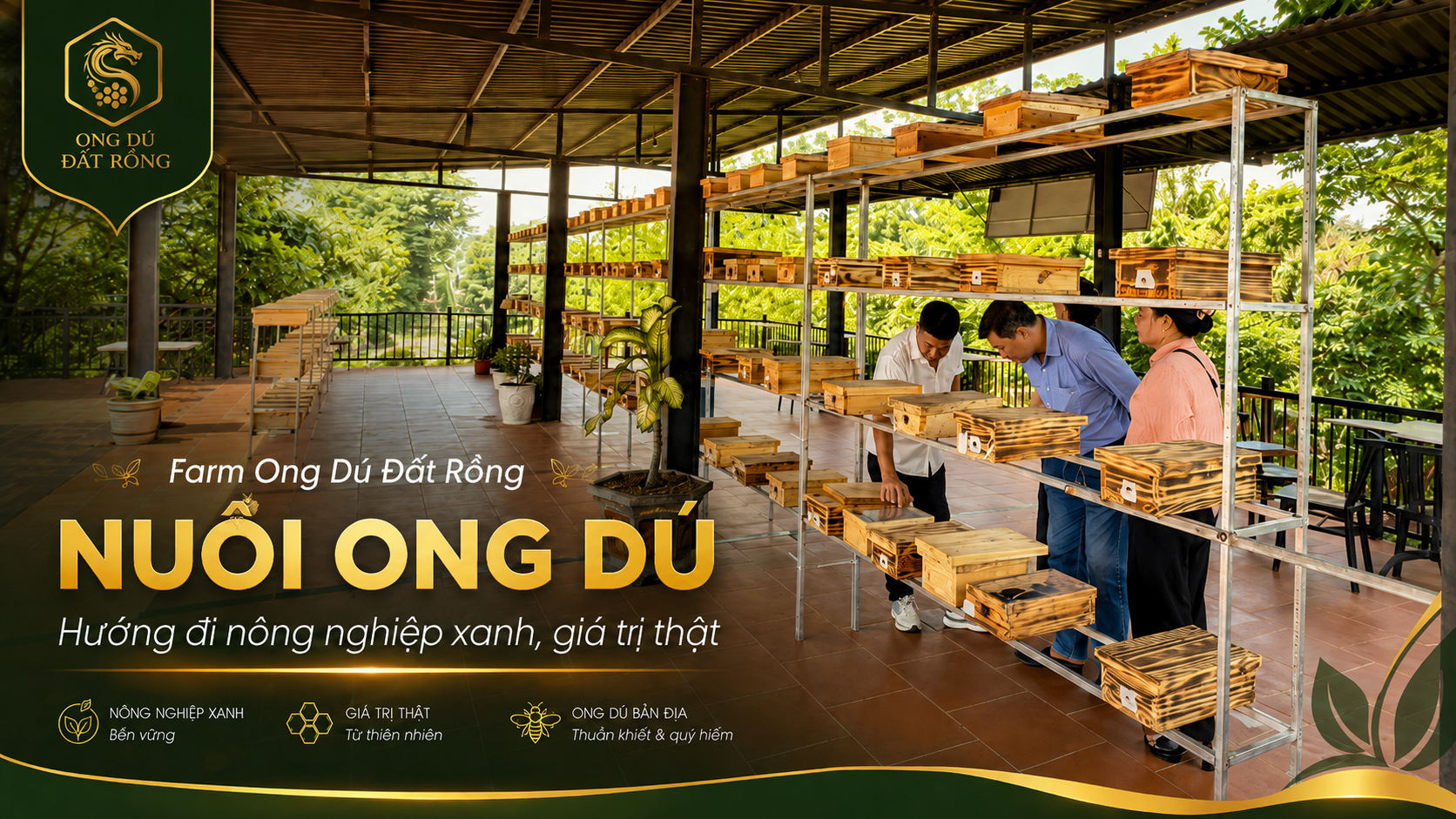
Small and gentle, yet holding enormous value — the stingless bee is gradually opening up a fascinating direction for people who love nature and are looking for a new farming model.
The stingless bee belongs to the group known as stingless bees – bees without an effective sting, distributed mainly across tropical regions. They do more than produce honey; they are also important pollinators in natural ecosystems and in agricultural production.
What makes the stingless bee special lies precisely in being “small but mighty”. A colony can be kept in a relatively small wooden hive box; when the surrounding environment offers suitable flowers, the bees fly out on their own to gather pollen and nectar, while the keeper concentrates on colony management, habitat and propagation technique.
Less honey – but a different kind of value
Compared with ordinary honeybees, the honey yield of stingless bees is usually not large. The honey is stored in the distinctive honey pots inside the hive (colony) and generally has a rich flavour, a gentle sourness and a runnier texture. It is exactly this limited yield, combined with those particular characteristics, that makes stingless bee honey a high-value product on the market. Scientific research also continues to explore the nutritional composition and the bioactive compounds in this special honey.
But the value of a stingless bee colony does not lie in litres of honey alone.
Bees also create value through breeding and colony multiplication, hive products, pollination support for crops, and the ability to combine with farm models, orchards, experiential tourism and nature education. The pollinating role of bees in general, and of stingless bees in particular, has been documented in a great deal of international literature.
Đất Rồng sees the stingless bee as an “ecosystem”
At Đất Rồng Stingless Bee Farm, we do not see a hive (colony) as merely a product to sell.
It can be the starting point of an entire ecosystem:
Breeding stock → Farm → Colony multiplication → Honey → Products → Experiences → Market → Community.
An orchard already growing crops can add stingless bees alongside them.
A farm can produce and, at the same time, become a place for people to visit and experience.
One initial colony can be cared for and developed into many colonies once the keeper masters the right technique.
That is exactly the direction Đất Rồng is pursuing: building a stingless bee model that is methodical, technically grounded, supported by a product ecosystem and backed by real outlets, instead of keeping bees haphazardly.
Keeping stingless bees is not “bring the hive home and leave it there”
Stingless bees are relatively gentle and caring for them has its own advantages, but keeping colonies healthy and multiplying them steadily still calls for knowledge of hive structure, flower sources, temperature and humidity, pests, seasons, colony splits and colony management.
The real value therefore does not lie in “keeping as many as possible”, but in keeping them with the right technique and building an outlet for the value the colonies create.
A small bee – a big direction
From a bee that in the past most people only happened to notice in a hollow tree, the stingless bee is steadily becoming part of high-value farming models. In Vietnam there are already households that have grown from a few initial colonies into farms with hundreds of colonies, earning income from both honey and breeding stock.
For Đất Rồng, the story does not stop at selling a hive (colony).
We want to turn every hive into a seed — so that from it grow more farms, more clean products, more green value and more sustainable business opportunities.
Đất Rồng Stingless Bee Farm
Raise one small colony – create an ecosystem of value