
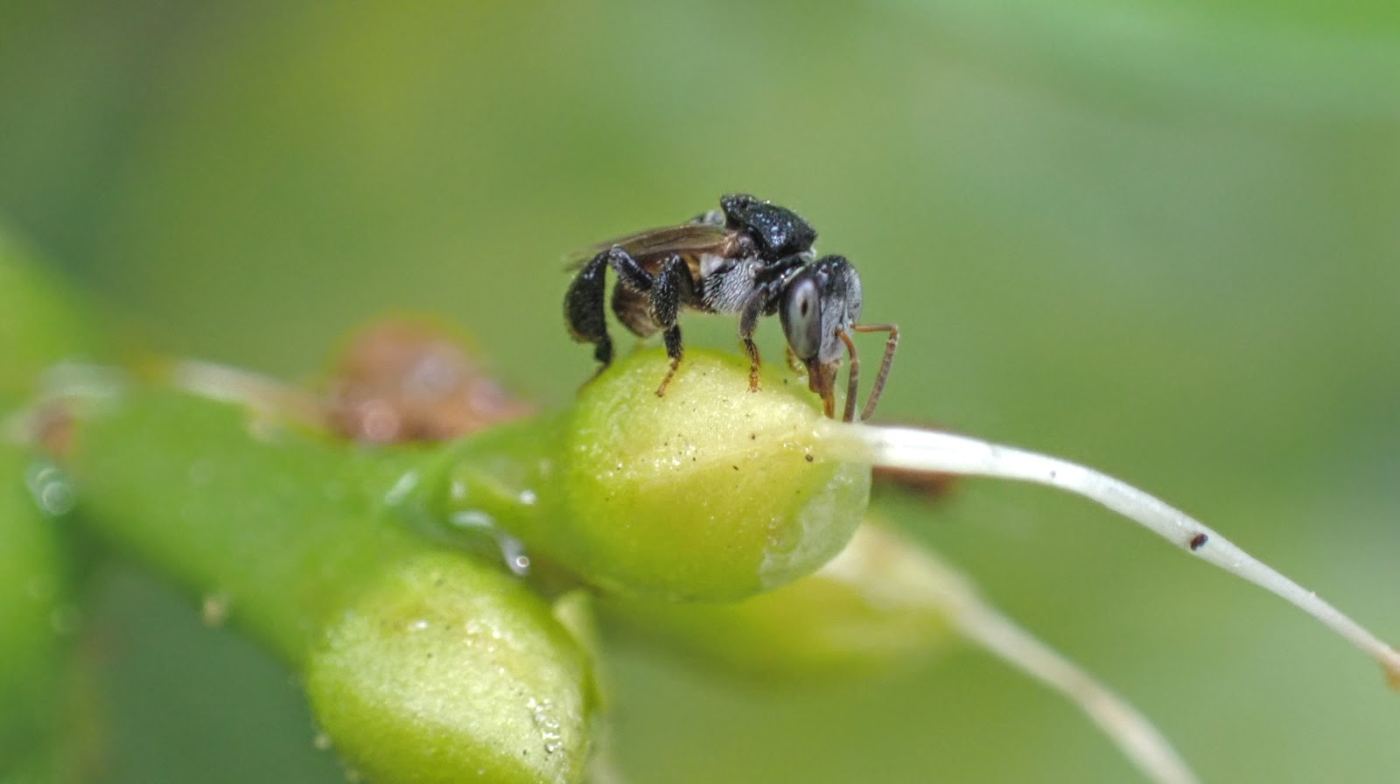
There is another way of looking at the stingless bee that most keepers overlook: stop treating it as livestock kept for honey, and start treating it as a tool for your orchard.
For many growers, the pollination value of a few stingless bee hives is worth more than the honey those colonies produce — many times more.
Why stingless bees pollinate so well
Three traits add up:
They are small. That is a strength, not a weakness. Stingless bees can slip into tiny blossoms and narrow floral tubes that a bulky honeybee cannot enter, or will not bother with. Coffee, many fruit trees, vegetable crops — all small-flowered.
They work hard within a narrow radius. Honeybees fly several kilometres, which means part of their effort goes to the neighbour's orchard. Stingless bees forage within a radius of a few hundred metres — almost all of their pollination work stays in your own garden.
They fly even when the weather is not fine. Stingless bees stay active in shade and in higher humidity — exactly when honeybees stay home. In a misty highland region such as Lâm Đồng, that is a meaningful difference.
Which crops benefit most clearly
- Coffee — small flowers that all open at once over a short window. Good pollination inside that narrow window has a direct effect on the fruit set rate.
- Tropical fruit trees — longan, lychee, mango, rambutan, avocado. Small flowers in dense clusters, exactly to a stingless bee's taste.
- Vegetables grown for fruit and seed — pumpkin, gourd, luffa, melon. Without pollination the flowers drop and the fruit comes out misshapen.
- Crops under netting — this is where stingless bees are especially valuable. Honeybees in an enclosed space tend to get stressed and batter themselves against the net; stingless bees adapt far better, and since they do not sting, gardeners can come and go freely.
How many hives for one garden
There is no rigid formula, because it depends on the crop, the planting density and the flower supply in the surrounding area. But there are principles:
- Spread them out, do not pile them into one spot. Because the foraging radius is narrow, putting every hive in one corner of the garden means the opposite corner is barely visited. Several small clusters spread around work far better than one large cluster.
- Build up gradually, do not cram them in at once. Start with a few hives and watch for a season. If the colonies develop well, the garden can carry more.
- Look at the flower supply across the whole year, not just the main bloom. A garden with two months of flowers and ten months of nothing cannot keep colonies alive until the next season.
The price you pay: giving up pesticides
This part is non-negotiable, and it is also why many growers never get past the idea stage.
Keeping bees in a garden means that garden has to cut plant-protection chemicals to the absolute minimum, especially the groups that are toxic to bees. You cannot spray on a regular schedule and hope for healthy colonies at the same time.
But look at it another way: many growers who have switched to ecological farming say that having bee colonies in the garden is the best possible motivation to drop the sprays — because now spraying carries a cost you can see straight away.
And a chemical-free garden sells its produce at a better price. The equation is not simply the money lost on pesticides; it is a switch to a different model altogether.
How to value it properly
If you are weighing this up, do not count only the honey money. Count all of it:
- The difference in fruit set rate before and after the bees arrived.
- The selling price of your produce once you switch to clean farming.
- The pesticide costs you no longer pay.
- The value of the colonies you split off each year.
- Honey — usually the smallest item on this list.
Many growers only realise after a season or two that they had the order backwards from the start.
To get started, see the beginner's guide to keeping bees at home and how to arrange flower sources around the garden.