
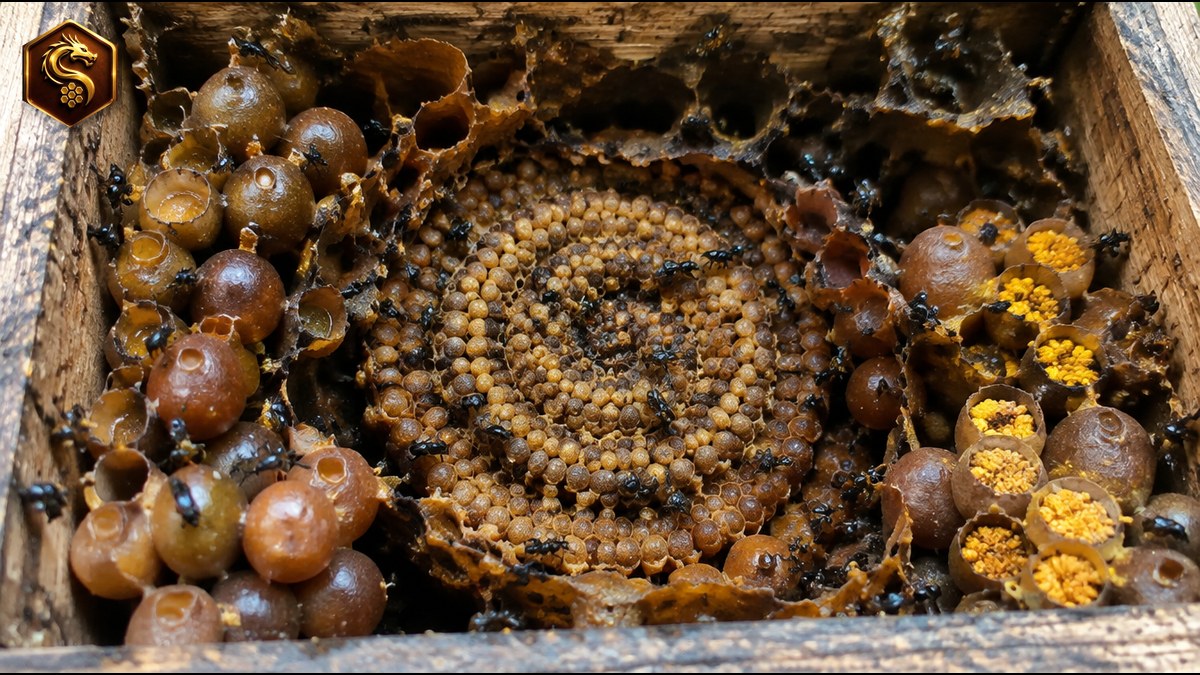
Splitting (dividing) is the most common and sustainable way to propagate stingless bees. Done right, one strong colony becomes two healthy ones. Done wrong, you may lose both.
Golden rule: Split only when the mother colony is truly strong – not by the calendar, but by colony strength and available forage.
Signs a colony is strong enough to split
Thousands of bees in the box and busy entrance traffic on warm, sunny mornings.
A large brood area, roughly one-third to one-half of the box cross-section.
Plenty of honey and pollen stores – a sign that forage outside is good.
Hive weight rising steadily across weighings.
If stores are low, forage is lacking – do not split yet.
The right time to split
At the start of the flowering season, when the weather is warm and forage is increasing, so new colonies have time to recover.
Avoid long rainy or cold spells; check the forecast for the next few days.
Choose a dry day and work quickly and neatly.
Equipment
A new box of the same size, clean and dry (stackable modular boxes are most convenient).
A thin clean knife or hive tool, tape and straps.
A tray, clean cloth and thin gloves.
Step-by-step splitting
Separate the box through the middle of the brood so each half gets a similar amount of brood comb.
Make sure each half has both young brood and emerging brood (lighter colour). Unlike honeybees, stingless bees do not rear a new queen from eggs on demand; the queenless half will get a new virgin queen from existing queen cells.
Add an empty super to each half so the bees can keep building.
Add a few honey and pollen pots to any half that lacks stores.
Seal all gaps and strap the boxes tightly to keep out ants and flies.
Place the new hive in the old spot or well away from it as advised; avoid placing hives too close together to reduce drifting.
Aftercare
Time | What to do |
|---|---|
First 1–3 days | Do not open; check for ants and flies around the joins |
1–2 weeks | Watch the entrance: bees bringing pollen and resin is a good sign |
4–8 weeks | Check for new brood comb to confirm the queen is laying |
Common splitting mistakes
Splitting weak colonies or splitting repeatedly, exhausting both colonies.
Leaving gaps – phorid flies lay eggs and the colony rots.
Breaking many honey pots; leaking honey attracts ants.
Splitting in the rainy season or when flowers are scarce.
Frequently asked questions
How often should stingless bee colonies be split?There is no fixed schedule. Go by colony strength and forage; a strong colony in a good flowering area can be split once it has fully recovered and filled its box.
Yes. Stingless bee colonies usually have queen cells or virgin queens available, so the queenless half will get a new queen if it has enough brood and workers.