
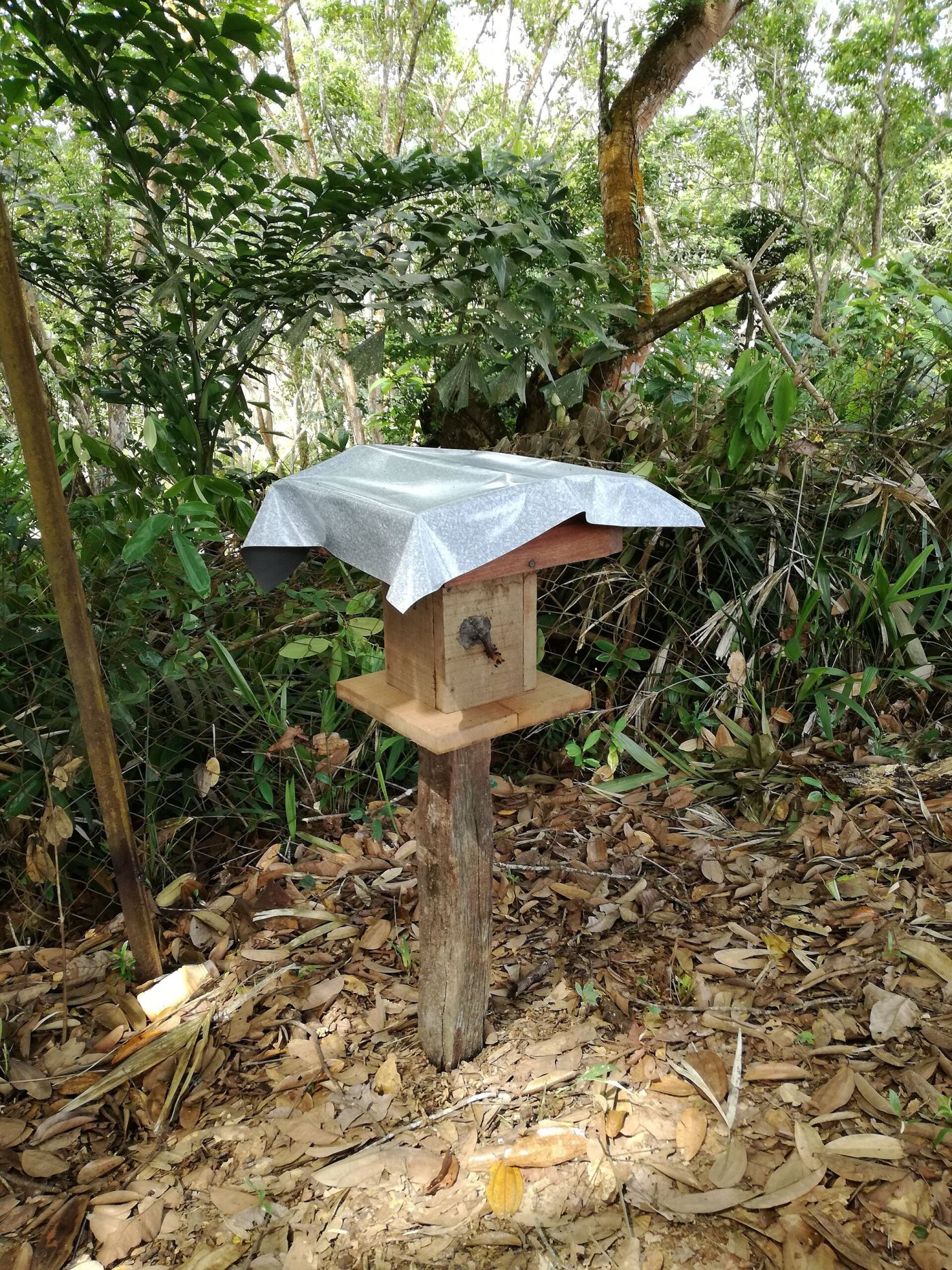
New beekeepers often run into a paradox: the garden is full of flowers, yet the colony stays weak.
The answer lies in the tongue. Stingless bees are several times smaller than honey bees, and their tongues are much shorter as well. Large flowers with deep floral tubes — lilies, big hibiscus blooms — may look beautiful, but stingless bees simply cannot reach the nectar inside.
Planting flowers for stingless bees means planting small flowers with open petals and shallow centres. The simpler, the better.
Stingless bees take two things from flowers
This distinction matters, because most people think only about nectar:
- Nectar — the energy source. The bees store it in resin pots, where it ferments into the honey we harvest.
- Pollen — the protein source, used to raise the brood. Without pollen a colony cannot grow its population, no matter how much honey it has.
A colony that is losing numbers is usually short of pollen rather than nectar. When you choose what to plant, deliberately cover both groups.
Easy plants that flower well
Heavy pollen producers
- Maize (corn) — enormous amounts of pollen; when the tassels open the bees cover the field.
- Squash, gourd and luffa — the flowers are large, but the reproductive parts are exposed, so stingless bees get in easily.
- Daisy-family flowers — marigold, globe amaranth; easy to grow and flowering continuously.
- Vegetables left to bolt — mustard greens, coriander, spring onion. A useful trick: do not pull up every old plant, leave a few beds to flower for the bees.
Good nectar sources
- Coffee — the coffee blossom season is the golden season in Tây Nguyên (the Central Highlands) and Lâm Đồng.
- Longan, lychee and mango — familiar fruit trees whose small flowers suit stingless bees.
- Rambutan and jackfruit — plenty of flowers and good foraging.
- Acacia and melaleuca — if there is planted forest near your home, this is a steady source.
- Basil, Vietnamese balm and perilla left to flower — small but effective, and handy to pick for the kitchen.
Arranging the garden for flowers all year round
This is the important part, and also the part most often skipped.
A garden with one glorious flowering season followed by three empty months puts the colony through a cycle of feast and famine. During the lean months the bees eat into their stored honey, the population falls, and disease becomes more likely.
What works in practice:
- Draw up a flowering calendar for your own garden. Write down, month by month, which plants are in bloom. The empty months will jump straight out at you.
- Fill the gaps with short-cycle plants. Marigold, dwarf sunflower, vegetables left to bolt — sow them a few weeks apart so they flower one after another.
- Keep one corner "wild". Many weeds flower generously, and they do it once the cultivated plants have finished. An uncleared corner of the garden is sometimes worth more than a carefully tended flower bed.
The biggest danger is not a shortage of flowers
It is pesticide.
Stingless bees forage within a radius of a few hundred metres — which means the neighbour's garden is inside the affected zone too. A single spraying while the plants are in bloom can wipe out most of the foragers that are out working.
A few ways to limit the damage:
- Talk to your neighbours about their spraying schedule. It sounds simple, but it is the most effective step of all.
- If spraying is unavoidable, do it in the late afternoon once the bees are back in the hive, and avoid spraying at peak bloom.
- Cover the hive entrance with damp netting on the day of spraying and the day after.
- Favour biological preparations in the areas closest to the hives.
In this system, when a farm records that spraying has taken place, an area alert is created for every hive (colony) on that farm so the technical team can pause honey harvesting and keep hive openings to a minimum. It sounds like a small detail, but records like these are exactly what decides whether the honey is clean.
Is supplementary feeding necessary
Only when it truly is. During a long rainy season or a dry spell with no flowers, if the colony has run down its stores, you can feed a dilute sugar syrup.
But remember two things: stop as soon as the flowers return, and do not harvest honey while supplementary feeding is under way — what is in the pots then is not flower honey.